Saturday, February 16, 2019

A sharp dressed man

Some  pieces of this story are things my Daddy told us growing up.  Unfortunately some details are missing and there's no one left to ask.  Write down or record the stories your parents tell you now. 
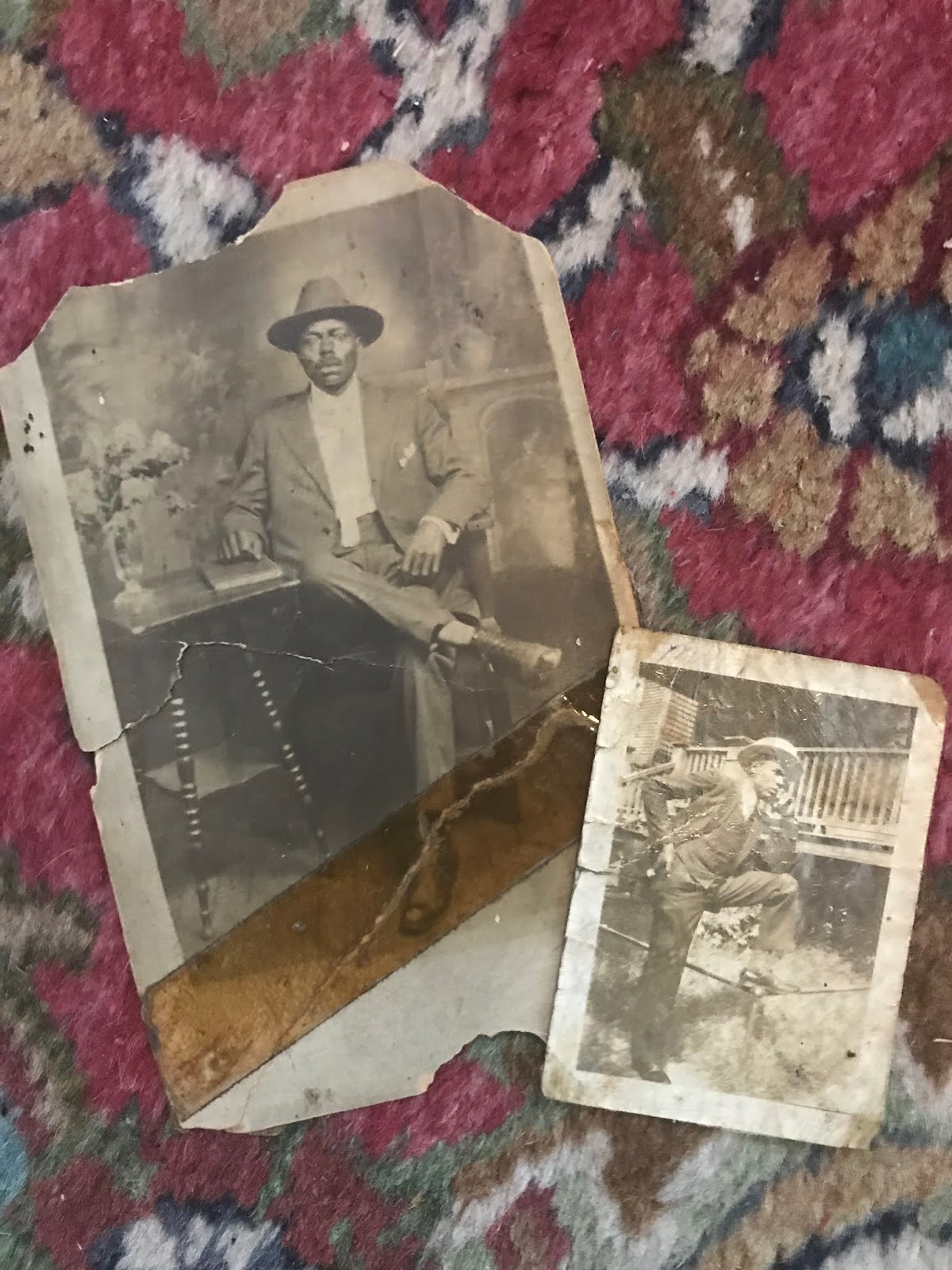
This story begins...There is no doubt that my Daddy was a sharp dressed man from a young age.  Born in 1923 in Ripley, Tennessee Daddy came from a long line of sharp dressed men, first his grandfather and later, his father. 
                                            pictured is my great grandfather born 1866 and
                                                          my grandfather born 1897

These are not the images that many of us have in our heads of African Americans born so close to the signing of the Emancipation Proclamation.  One of the family stories that Daddy told was that he had an uncle who was a tailor in Memphis, Tennessee.  His uncle was so talented that he could have a customer stand in a corner of his shop and hold his thumb up in different positions  while looking at the customer and shout out measurements for my Daddy to write down.  With few other measurements he would create a suit that was tailored to perfection.  One of his uncle's most well known customers was Memphis politician Edward Hull "Boss" Crump. So infamous was this politician that W.C. Handy wrote a song about him titled Crump Blues.


 Daddy wore many custom made suits that were created by his uncle.  He had an amazing sense of style throughout his life.  He loved hats, sharp leather shoes, and french cuff shirts.  Daddy wore a suit to church every Sunday.  He taught his grandsons the importance of being dressed for success and taught them the correct way to tie a necktie.  For Daddy there was 'dressed' or 'not dressed.' It was many years before he would wear short sleeve shirts or jeans.  For him, his clothes said something about who he was.  Daddy was a gentleman who believed strongly in tradition and his presence commanded attention because he was so well put together.  The legacy of all these sharp dressed men can be seen in the way we dress today, with an eye for style.  What is left from the stories of my great uncle is a suit and his tailor's scissors along with photographs and warm memories of days gone by. 


Monday, February 11, 2019

The Hair Journey


The First journey 
I was born with wavy, curly hair.  As I grew, my hair turned more coarse and kinky.  My mother  brushed  and combed my hair and I wore braids a good part of childhood.  It was the practice in our home that every couple of weeks, to keep your hair soft and your scalp healthy Mama would oil our scalp.  She would part it into small sections and apply a little Vaseline or Hair Rep.  Mama knew how to french braid our hair and occasionally we would have a different do.  Sometimes our Daddy did our hair and it would be braided  so tight that it gave our eyes a bit of a surprised look.  Daddy's hair dos stayed tidy for several days and only needed a small amount of brushing to put loose hairs back in place.

                                                                        The Second Journey

For special occasions we got our hair pressed.  This was an all day ordeal.  We had a family friend that would come over for this.  First, you'd get your hair washed nice and clean then it was parted into sections and combed through.  After your hair was dry you waited your turn to get 'in the chair'.  Our family friend would do my two sister's hair then mine and sometimes my Mother's hair.  A hot comb was placed on the stove until it was very hot.  Then the comb was cooled just a bit by wiping it on a towel.  A small section of your hair would be parted, oil (Hair Rep) added and the the comb was applied.  It was an art, if the comb was too hot it would burn your hair and it could fall out.  But just the right amount of oil and the right temperature comb worked like magic.  The hot comb was dragged from the scalp to the end of the hair.  This was repeated until all the hair was straightened.  After that the curling iron was heated.  Small sections of your hair were parted and the curling iron twisted into your hair creating a large curl.  Afterward your hair could be styled any way you wanted.  I remember feeling so glamorous and pretty after the long ordeal.  We wore foam rollers to bed and tied our hair in silk scarves to protect it.  This 'pressing' would last several weeks.  Water and any kind of moisture would undo a pressing.
 
                                                             Journey Three-The age of perms
 For many African Americans a perm was a way to straighten the hair. (I can remember many conversations with my white friends about why I permed my hair.  Their experience was that perming your hair was a way to get waves and curls, the exact opposite of the reason African Americans permed their hair)  Chemicals were placed on your hair, combed through and then rinsed out.  The process took an hour or so but the results were like pressing your hair and it didn't take all day.  Perms lasted longer but moisture was still not our friend.  Moisture would take the curl out of your do.  After a perm you could roll and set your hair overnight and style your hair in the morning.  This required sleeping on rollers overnight for years and avoiding getting your hair wet or damp.
 
                                                             Journey Four- The Natural/Afro
As styles changed and our country changed African American hair reflected the times.  We went from being Negroes to being Black and Proud, both of who we were and what we looked like.  We embraced our skin color and our kinky hair.  Proud Blacks sported the Afro or Natural.  For me this was an exciting time.  At last we could wear our hair the way it grew out of our heads, no chemicals, low maintenance and all you needed was an afro-pick.  (Truthfully we still fussed over our hair to make sure it was shaped right and attractive and for many women the more like Angela Davis the better).  A Natural for me meant freedom, we were redefining what beautiful meant. 


 After the 70's we had a choice of what we wanted our hair to look like.  Perms were back, some people continued to wear a Natural but s shorter, closer version.  I experimented with a couple of New Wave styles before getting a Hairdresser that cut my hair in such a way that it reflected my life style.  I tried some crazy colors and at last went back to the new and improved perm.  This meant going back to rollers and now a hot curling iron.  My hair took 30-45 minutes in the morning before work.  I liked how it looked so I made the sacrifice.

The last leg of my journey was one that I struggled with the longest.  I remember seeing Whoopi Goldberg for the first time and wondering what she had done to her hair.  I didn't dislike it, and I became curious about it.  I grew to love it and wanted to take the plunge myself.  It took me years before I decided to do it,  then in 1999 I decided to lock my hair.  I went to my hairdresser for the last time and told her to cut my hair.  She cut my hair to 1 inch all over.  When my hair grew to 2 inches the process began.  At 2 inches I found a Salon that specialized in dreadlocks or locked hair.  The hair stylist washed my hair and twisted sections of my hair.  Every 2 weeks I came back to have this repeated.  After several months the twisted hair started to adhere to itself or "lock."  I continued trips to the Salon for about 4 months.  After my hair locked, I could take care of it myself and no longer went to the Salon. (in fact I haven't been back since)  Locked hair can be washed and styled and colored and cut and  it stays locked.  To date this has been my favorite hair style.  It's natural, I can get it wet, it's a statement, I can sleep on it, and I just wash it and go!  I will admit it does take a while to dry naturally but in the Summer it's great!  It's also been a great teaching tool.  When I was teaching young children were curious about it and so I simply explained how my hair came to be like it is, I often invited them to touch it and they were surprised at how it felt.  On the other hand not so young adults were equally as curious and just simply touched without asking.  I have corrected some and asked others please not to and given them the same explanation as the children. It's a great lesson in respecting personal space.   Other adult friends are curious and I sometimes invite them to touch it.  It's an odd thing, this is the only hairstyle I've had that elicited that response.


                              These old School Ids show a little bit of the dreadlock journey. 

I've already begun thinking about what the next hair journey might look like.  Just wait and see, it's bound to have a story. 

Sunday, February 10, 2019

Teaching is in our blood

     Mary Magdalene Carson was born in 1899 in Ripley, Tennessee.  Mary disliked her name and instead changed it first to Magalene then to Maggie L.  Friends and neighbors called her Miss Maggie.  We visited Grandma Nelson (what my siblings called her)  in the summers down in Memphis, Tennessee.  She would proudly take us around and introduce us to her friends. Grandma sent us to church on Sundays and tied  money for church in the end of our handkerchiefs. Miss Maggie had a beautiful garden and a big front porch where the grown ups sat in the evening on her rocking chairs and my personal favorite, a glider.  Inside her home I remember  a grandfather clock, a piano, a fancy telephone chair,  and a beautiful vanity in her bedroom and a dining room table with clawed feet.  Her closet was filled with old Jet magazines we'd spend hours looking through.  In the morning the house smelled like bacon and coffee, Grandma even let us have coffee with our breakfast.  (A lot of milk and sugar with a splash of coffee).  There are fond memories of many summer trips.  After she died   I found out more about my grandmother that I failed to ask when we visited.  I had known from an early age that I wanted to teach and my Mother was an educator.  To my surprise and delight I found that Grandma Nelson had been a teacher.  She taught in a one room school house with a mixed age group of students.  Grandma received her teaching license in July of 1918.  Who knew?  Teaching is in our blood. 


                                A framed  Mother of pearl vanity set given to my Grandmother
                                        as an Anniversary gift.

Wednesday, February 6, 2019

Playground fun back in the day


I was looking through the late Patricia C. McKissack's book, "Let's Clap, Jump, Sing and Shout; Dance, Spin and Turn it Out!" Games, Songs and Stories from an African American Childhood and was at once transported back in time to the playground and playing outside.  A good part of our childhood was spent outside creating things, building screen houses, having mud pie teas and making up games. Songs, chants, jump rope rhymes and hand claps were a huge part of childhood play. I often wondered why after the Doctor and the Nurse were unable to heal you why they called on The Lady with the alligator purse.  Who was she?  What training did she have?  No matter the situation when in doubt, call for The Lady with the Alligator purse.  I have fond memories of our neighborhood playground in walking distance of our first home. I didn't realize it at the time but Handy park, in St. Louis, was named after a famous African American.  On June 22, 1960 W.C. Handy Park was dedicated in honor of William Christopher  Handy (1873-1958), the world famous composer of the "St. Louis Blues."  At Handy park I learned to swing and mastered pumping my legs to make the swing go higher, we climbed on the jungle gym and  spent endless spins on the metal merry-go-round.  We conquered fears of going on the high metal slide and hanging on the arch shaped monkey bars.  We'd walk home from the park feeling tired and very proud of our accomplishments.  If you get a moment, check out Patrica McKissack's book, it's a treasure trove of childhood memories.  


Monday, February 4, 2019

The Importance of an Education


     Mama believed in education.  Born in 1925 she grew to understand that education was a way out of poverty.  Kathryn Bryan was born in Detroit, Michigan and moved at the age of three to Memphis, Tennessee.  Her Big Mama ( grandmother) taught her to read before she started school.  For a time she attended an experimental school.  A white woman who had worked at a finishing school for young white girls wondered if African American children could learn the same as white children. Kathryn excelled.  She went on to attend Booker T. Washington high school in Memphis where she graduated with honors.  Kathryn's hard work paid off, she earned a scholarship ($75.00) to attend LeMoyne Owen college.  Upon graduation she left Memphis for New York to study Social work and Religious studies at Columbia College and Union Theological Seminary. Kathryn Bryan received her Masters in Social work and Religious education.  Education was a way out and she taught that to her children.  At age 13 I knew what I wanted to be....an Educator.  With Mama as a role model the choice was simple, I never changed my mind.  


Saturday, February 2, 2019

Martin Luther King


     I was in Elementary school when Martin Luther King was assassinated.  Long before Martin Luther King's legacy was framed by the now iconic "I have a dream speech" at the March on Washington for Jobs and Freedom in August of 1963, he was  well respected in the African American community.  To many, he was a welcomed figure who spoke eloquently about the struggles of African Americans and was one of many leaders in the modern Civil Rights movement that spanned from 1954-1968.  I remember my father listening to "The Great March to Freedom" over and over in our home (his copy pictured above). I remember Ebony magazine highlighting Dr. King's life and the magazine on our coffee table.  My mother had a copy of a comic book that featured Dr. King and talked about the Montgomery Bus Boycott.  I remember being fascinated by the comic with all the Black people in it,  featuring a real life person I knew from the news.  We learned about Dr. King as a key figure in the Civil rights movement.  We also learned that it was not a movement that was just about him but a movement of the people.  Martin Luther King was such an important figure that he was memorialized on velvet, decoupage, posters and plates that allowed many African American homes to display King's portrait in a place of honor.  He offered hope to a people and his message resonated with not just the African American community.  When sharing Dr. King's legacy I like to remind learning communities that Dr. King was an ordinary person who lived an extraordinary life.  He gave many speeches, some more moving the than the "I have a dream speech"  that still continue to inspire.  He was dedicated to  making life better for everyone.  He was profound and a great example of a servant leader that reminds us of the gift of Hope. 


Thursday, January 31, 2019

An intersection of Black and History....Happy Black History Month!

     Every year I strive to  share more Black History outside the month of February.  The month comes and it's time to celebrate again with new goals to meet, sharing the history of all of us.  This year I thought I'd try a new spin.  Black History month 2019 I will share some collections from the Hands on Black History collection, artifacts, books, photos and  and my own personal stories in Black History.  My hope is to help readers understand how history is living, it has a past a present and a future. As always I hope to educate and stimulate along the way.  Please check in this month to see how the story progresses.  Happy Black History Month!