Here are some fun and interesting facts about Frederick Douglass.
#1 As a young man in Baltimore, Douglass learned to play the violin. It was a hobby he enjoyed the rest of his life.
#2 Douglass met President Abraham Lincoln three times during the Civil War. After the president died, Mrs. Lincoln gave her husband's favorite walking stick to Douglass.
#3 Douglass became active in the Underground Railroad. His home in Rochester, New York, was a stopping place. Runaway slaves could hide there until it was safe to travel to the next stop. Today, people can visit there.
#4 Douglass was know as a great storyteller. He often made family, friends, and audiences laugh with his tales.
#5 Douglass wrote three books about his life: Narrative of the Life of Frederick Douglass, My Bondage and My Freedom, and the Life and Times of Frederick Douglass.
#6 In 1899, four years after Douglass died, a statue of him was built in Rochester, New York. It was the first time an African American was honored with a statue.
taken from National Geographic Kids "Frederick Douglass" by Barbara Kramer
Monday, February 5, 2018
Sunday, February 4, 2018
Most photographed American of the 19th century
Frederick Douglass was the most photographed American of the nineteenth century. "To Douglass, photography was the great "demographic art" that would finally assert black humanity in place of the slave "thing". Douglass stated, "Every colored house holder in the land should have one of these portraits [of a black leader] in his parlor, and should explain it to his children, as the dividing line between the darkness and despair that overhung our past, and the light and hope that now beam upon our future as a people." His portrait gallery contains 160 photographs.
taken from "Picturing Frederick Douglass An Illustrated Biography of the Nineteenth Century's Most Photographed American " by John Stauffer, Zoe Trodd, and Celeste-Marie Berner
Saturday, February 3, 2018
Frederick Douglass for Children
There are lots of good books about Frederick Douglass to share with young learners as well as the young at heart. Books that teach about famous African Americans are wonderful conversation starters. I have used books with children as young as Kindergarten and had some inspiring lessons. Choose carefully for the kind of experience you want young learners to have. Here are a few things I look at when choosing an appropriate book.
For children a little older, timelines are helpful in giving children idea of when events happened. Illustrated timelines add another layer o dfeeper understanding for visual learners.
Books that offer activities connect children to history and give a hands on approach to learning about the life and times of famous African Americans.
Books that have a combination of illustrations and actual photographs help children understand that these are real people.
These are tips I use frequently when working with a variety of Elementary students. I have had some really engaging lessons when I chose my books carefully.
Frederick Douglass was a fascinating figure in our country's history and children are never to young to learn about important leaders. Celebrate Frederick Douglass' 200th birthday with a good book!
Frederick Douglass Coloring Book by Gary Zaboly Dover Coloring Book
National Geographic Kids Frederick Douglass by Barbara Kramer
Frederick Douglass for Kids His Life and Times with 21 Activities by Nancy I. Sanders
Lincoln and Douglass an American Friendship by Nikki Giovanni
A Picture Book of Frederick Douglass by David A. Adler
Frederick Douglass The Lion Who Wrote History by Walter Dean Myers
For young children illustrations are important. For non and beginning readers it is important to have good illustrations that help tell the story and spark interest. For very young children choose books that are not too lengthy and have a clear message about the importance of the figure's life. If my only choices for books are lengthy ones but the illustrations are good, I may read parts of the book and story tell the rest. Familiarize yourself with the book ahead of time if this is the case.
Books that offer activities connect children to history and give a hands on approach to learning about the life and times of famous African Americans.
Books that have a combination of illustrations and actual photographs help children understand that these are real people.
These are tips I use frequently when working with a variety of Elementary students. I have had some really engaging lessons when I chose my books carefully.
Frederick Douglass was a fascinating figure in our country's history and children are never to young to learn about important leaders. Celebrate Frederick Douglass' 200th birthday with a good book!
Frederick Douglass Coloring Book by Gary Zaboly Dover Coloring Book
National Geographic Kids Frederick Douglass by Barbara Kramer
Frederick Douglass for Kids His Life and Times with 21 Activities by Nancy I. Sanders
Lincoln and Douglass an American Friendship by Nikki Giovanni
A Picture Book of Frederick Douglass by David A. Adler
Frederick Douglass The Lion Who Wrote History by Walter Dean Myers
Friday, February 2, 2018
Sterling Ashby
In the early years of the museum's creation I decided that what might enhance the student's understanding of Black history was to add guest speakers. Our first guest speaker was Sterling Ashby. I was shopping on line for things of interest to use in the museum and I came across HIA toys (History in Action). There were 3 Black figures, beautifully and thoughtfully made and I ordered all 3. I loved them upon arrival and immediately sent feedback to the company telling how I would use them with the museum. The owner, Sterling, responded and thanked me for purchasing the toys, our friendship began. He wanted to know about the museum and I shared, we eventually chatted on the phone "If there's anything I can do for you in the near future, let me know." This opened the door for our first guest speaker to appear as the museum guest. Sterling came from Washington D.C. and shared a beautiful presentation with the students at my school and brought many of the figures to share with the students.
We kept in touch for the past 10 years and he continued to enjoy hearing about Museum adventures. I am sad to report that Sterling was diagnosed with a rare form of brain cancer and died shortly before his January 30th birthday. He would have been 49. I am so fortunate to have crossed paths with this kindred spirit. I wrote Sterling once and told him, he was one of my heroes and thanked him for sharing. R.I.P. dear friend, I'll continue to care for and use your action figures to teach our history.
Wednesday, January 31, 2018
And We're Back!
Black History Month 2018
It's been a while since my last post and a lot has changed. The internet swallowed the old website so we've created a new Hands On Black History website. Check it out you'll like the new look and you can follow posts throughout the month as well as work we've done throughout the past years as well as the upcoming year.
Black History month 2018 we're celebrating the 200th birthday of Frederick Douglass. If you're in the St. Louis area during the month you can check out an illustrated timeline of the life of Douglass on display at Christ Church Cathedral in downtown St. Louis. This month I'll be sharing museum travels as I have several opportunities to talk with groups about the many contributions of African Americans. Also, I'll be sharing new vintage photos from my growing collection of photography of African Americans and new museum artifacts. I look forward to celebrating this important history with you because," Black History is the history of all of us."
It's been a while since my last post and a lot has changed. The internet swallowed the old website so we've created a new Hands On Black History website. Check it out you'll like the new look and you can follow posts throughout the month as well as work we've done throughout the past years as well as the upcoming year.
Black History month 2018 we're celebrating the 200th birthday of Frederick Douglass. If you're in the St. Louis area during the month you can check out an illustrated timeline of the life of Douglass on display at Christ Church Cathedral in downtown St. Louis. This month I'll be sharing museum travels as I have several opportunities to talk with groups about the many contributions of African Americans. Also, I'll be sharing new vintage photos from my growing collection of photography of African Americans and new museum artifacts. I look forward to celebrating this important history with you because," Black History is the history of all of us."
Sunday, March 8, 2015
Women in the March
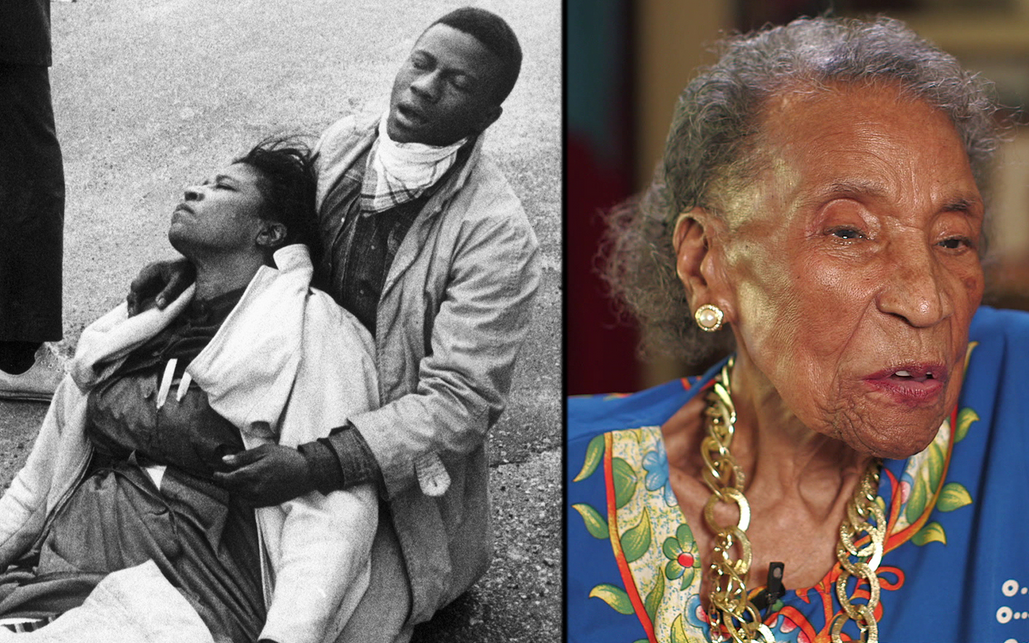
Amelia Boynton became one of the first African Americans to register to vote in Alabama in 1932. The following year she worked to register others forming the Dallas County Voters League. After working decades with little success, Boynton encouraged the SNCC to come to Selma to help.
In 1964, Boynton ran for Congress as a Democrat, making history as the first African-American woman to seek national office in Alabama. Later that same year she sought additional support for her efforts in Selma. Other civil rights activists recalled Ms. Boynton approached Dr. Martin Luther King Jr. in late 1964 and asked that he come to Selma and help. It is believed that is where the Selma movement started. She inspired King and members of the SCLC to take action in Selma.
Read More
Monday, March 2, 2015
Women's History
Our celebration began with what is traditionally recognized as "Black History Month". Our celebration continues with "Women's History Month" . I will start the celebration with one of, if not my favorite, women in history, Kathryn Nelson. The strong bias is not simply because she was my mother but because she remains one of the most amazing women I have ever known. I have shared information about Mama before so I'll make this entry in the form of a timeline.
Five years later her family moved to Memphis, Tennessee where she grew up.
Kathryn attended a private Elementary school in Memphis. The school was an experiment. The school's head mistress, had previously taught at a finishing school. Her goal was to determine if young Black children could be taught similar skills taught to white children. Because Kathryn could read upon starting school and was very bright, she skipped grades.
Kathryn went on to attend a public high school in Memphis. (I think it was Booker T. Washington)
She was a member of the marching band and played trombone. (I recall her saying she played very badly, but had fun playing) In one of her stories about high school she said a special visitor to their school was W.C. Handy.
Kathryn graduated from high school and received a scholarship from the Delta Sigma Theta sorority and enrolled in LeMoyne-Owen College in Memphis. Kathryn was 17 years old.
Kathryn met Clyde Nelson and they dated until he joined the army to fight in World War II. He would return to LeMoyne after the war and complete his degree.
Kathryn obtained a degree in social science in 1946.
Kathryn left Memphis after graduation and simultaneously attended Columbia University Teachers College and Union Theological Seminary in New York. In 1948 she earned a joint degree, a Master's of Arts in religious education.
.jpg)
Kathryn returned to St. Louis to reunite with her college sweetheart and they were married September of 1952.
Kathryn held a variety of jobs and was once described as a "champion for persons of less chance." Jobs included working with children on the Navajo reservation at Fort Defiance, Arizona, social worker at Annie Malone Children's Home, director of the Junior Kindergarten at the Page Park YMCA, the Channel 9 series she created and hosted, "Growing Together", faculty member and administrator at St. Louis Community College at Forest Park, and program director at the Danforth foundation. She spent endless hours in meetings and sat on a variety of boards in the St. Louis community. She served on the board of directors of the St. Louis Public Library Board, was a trustee at Webster University, co-chair of the Forest Park Master Plan committee and was a board member of St. Louis 2004. (to name a very few)
Mama was a wise woman and very intelligent. She loved learning and was a voracious reader. She had a way of telling you what you needed to hear rather than what you wanted to hear. Mama was a great listener and had a gift of bringing people together. She was comfortable in her own skin and folks enjoyed being around her. In the book "Hitting Our Stride" by Joan Cohen, Karen Coburn and Joan Pearlman, Mama talks about aging, she was 54 at the time the book was written. She says, " I've come to see that for the really vital women, there's that zest for living; they can laugh and find joy and do what they want and make a contribution to the world." Mama had a zest for living until her last day and her contributions were many, she was truly an amazing woman. I miss her daily.
Subscribe to:
Posts (Atom)


.jpg)

.jpg)
.jpg)
.jpg)

.jpg)
.jpg)
.jpg)

.jpg)
.jpg)
.jpg)